
Financial model · Pre-deployment stage
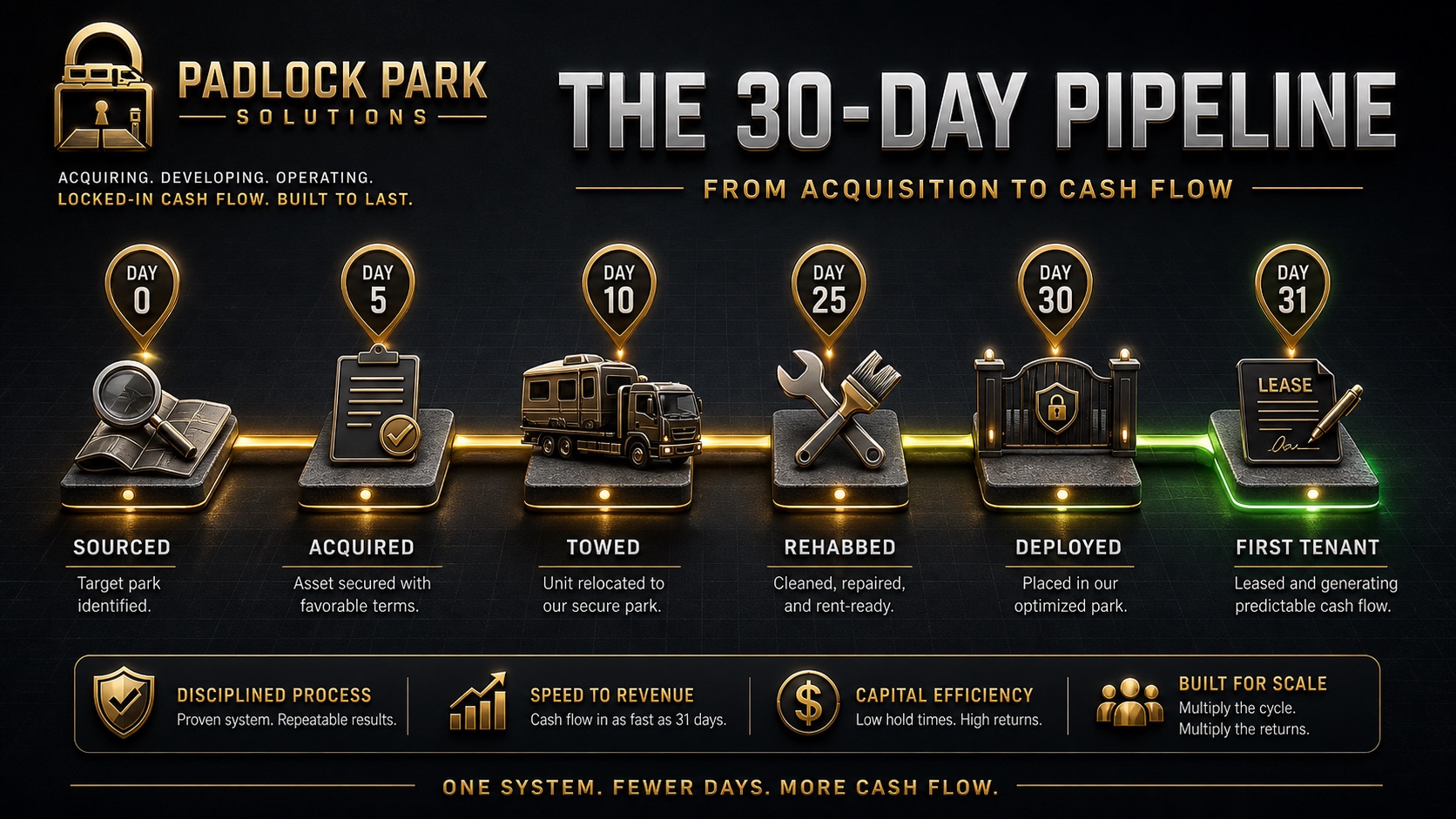
Projected economics for converting salvage Class A motorhomes into stationary workforce-housing or nightly-rental units. No completed pilots have been deployed.
Material disclosure
All financial projections on this page are modeled estimates. They are derived from: (1) observed salvage auction prices at Copart and IAA for Class A motorhomes with mechanical, chassis, and electrical damage designations; (2) Furnished Finder, Zillow, and Apartments.com comparable RV lot and furnished unit rents in secondary US markets; (3) published KOA, AutoCamp, and regional glamping operator ADR and occupancy data. No Padlock Park pilot has been executed. Results will vary materially by geography, unit condition, operator execution, and market conditions. Nothing on this page constitutes an offer of securities or investment advice.
The arbitrage
Two prices for the same asset.
Insurance companies write off Class A motorhomes as vehicles. The salvage market prices them as depreciated, non-drivable machines. The stationary housing market prices them as furnished habitations. That spread is structural and persistent.
| Metric | Salvage vehicle market | Stationary housing market | Spread |
|---|---|---|---|
| Market price for Class A motorhome (mech. damage, 2000–2015) | $1,800–$4,500 | N/A — not purchased at auction | — |
| All-in conversion cost (Padlock hard cap) | $7,500 per unit | $7,500 per unit | — |
| Monthly income yield | $0 (non-operational asset) | $700–$900 workforce housing, $1,200–$1,800 glamping | Categorical |
| Annual gross revenue per unit | $0 | $8,400–$21,600 | $8,400–$21,600 |
| Unleveraged yield on $7,500 deployed capital | 0% | 112%–288% gross | 112–288 pts |
| Comparable asset pricing (stabilized RV park pad) | N/A | 6%–10% cap rate on NOI | — |
Sources: Copart/IAA lot data, Furnished Finder market surveys, STR Research glamping benchmarks, CoStar RV park cap rate surveys
Cost structure
What the $7,500 cap covers.
The hard cap is the service deliverable. Every cost category below is included. Operator does not manage any line item — Padlock runs the full pipeline.
| Cost category | Typical range | Cap allocation | Who executes |
|---|---|---|---|
| Auction acquisition (Copart / IAA lot price) | $1,800–$4,500 | $1,800–$4,500 | Padlock |
| Buyer premium (17–22% of hammer) | $400–$900 | Included in acquisition line | Auction house |
| Pre-bid inspection (bonded 3rd-party inspector) | $150–$300 | $200 budgeted | Padlock-contracted |
| Flatbed transport to operator site | $400–$1,200 | $600–$1,200 depending on distance | Padlock |
| Habitability rehab (roof, seals, HVAC check, appliances) | $800–$2,500 | $1,500–$2,500 | Padlock |
| Interior package (cleaning, linen-ready, smoke detectors) | $200–$400 | $250–$400 | Padlock |
| Miscellaneous / contingency | Variable | ~$300 | Padlock |
| TOTAL HARD CAP | — | $7,500 per unit | Padlock delivers |
Cap applies per unit. Operator holds title to the unit. Padlock fee is the conversion service; unit asset is operator-owned.
Revenue model
Two monetization paths. One capital outlay.
Operators choose the path based on their market, zoning posture, and management capacity. The unit asset and the $7,500 cap are identical either way.
Path A — Workforce housing (12-month lease)
| Monthly rent / unit | $700–$900 | Furnished Finder / Zillow comparable |
| Annual gross / unit | $8,400–$10,800 | At 100% occupancy (no short turns) |
| OpEx reserve (maintenance) | ~$100/unit/mo | $1,200/yr per unit |
| Annual NOI / unit | $7,200–$9,600 | Excluding operator overhead |
| Unleveraged yield on $7,500 | 96%–128% | First full year |
| Payback period | 9–13 months | At $700–$900/month |
| Vacancy assumption | Low — stable tenants | Workforce demand structural |
| Management intensity | Low | Annual lease, stable tenant profile |
Path B — Short-stay / glamping (nightly rental)
| ADR (average daily rate) | $80–$150/night | AutoCamp, KOA Glamping comps |
| Occupancy assumption | 45%–65% | Secondary market, seasonal |
| Annual gross / unit | $13,140–$35,588 | ADR × occ × 365 |
| OpEx (cleaning, utilities, platform fees) | ~35–45% of gross | Higher than workforce housing |
| Annual NOI / unit | $8,500–$21,600 | Conservative to high scenario |
| Unleveraged yield on $7,500 | 113%–288% | First full year |
| Payback period | 4–9 months | Scenario-dependent |
| Management intensity | High | Booking, cleaning, guest ops |
Projections. Not guaranteed results. Operator market, execution quality, and unit condition materially affect outcomes.
Sensitivity analysis
Per-unit annual NOI across rent and occupancy scenarios.
Tenant model (left) and glamping model (right). $7,500 all-in basis throughout. Each table states its own NOI assumptions beneath it.
Tenant model — annual NOI vs. monthly rent
| Monthly rent | Annual NOI | Yield on $7,500 | Payback |
|---|---|---|---|
| $600/mo | $6,000 | 80% | 15 mo |
| $700/mo | $7,200 | 96% | 13 mo |
| $800/mo | $8,400 | 112% | 11 mo |
| $900/mo | $9,600 | 128% | 10 mo |
| $1,000/mo | $10,800 | 144% | 8 mo |
Assumes 100% occupancy (12-month lease). NOI = gross rent − $1,200 maintenance reserve.
Glamping model — annual NOI vs. ADR and occupancy
| Occupancy | $80 ADR | $95 ADR | $120 ADR |
|---|---|---|---|
| 35% | $7,028 | $8,346 | $10,530 |
| 45% | $9,180 | $10,901 | $13,757 |
| 55% | $11,332 | $13,457 | $16,985 |
| 65% | $13,483 | $16,012 | $20,212 |
NOI ≈ gross revenue × 70% (about 30% operating expense); margin improves modestly with occupancy. Conservative markets run lower.
Risk factors
What the model doesn't guarantee.
These are the material risks. We name them because an institutional investor will find them anyway — better to address them directly.
Hidden unit damage post-acquisition
MediumSalvage units can have undisclosed interior water intrusion, structural rot, or hidden electrical failures that pass pre-bid inspection but surface during rehab. Kill-switch rule: if rehab cost exceeds the cap, the unit is written off and sold for parts rather than absorbing overrun.
Market rent achievability
High variabilityThe $700–$900 workforce housing range and $80–$150 ADR glamping range are drawn from national survey data. Individual markets vary significantly. Rural markets with thin rental demand may not support the model. Pre-commitment local comp verification is the operator's responsibility.
Zoning and permitting
High — site-specificStationary RV occupancy for residential use is regulated differently in every jurisdiction. Some counties allow it under agricultural or RV park zoning; others prohibit it entirely. Padlock does not perform zoning diligence on operator sites. This is the operator's pre-commitment gate.
No completed deployments
FundamentalThe financial projections on this page have not been validated by actual deployed units. This is a pre-deployment stage business. The model is credible based on market data, but it has not been stress-tested by real-world execution, tenant default, or seasonal occupancy compession.
Operator execution dependency
MediumThe glamping path in particular requires ongoing guest operations, channel management, and maintenance execution. Padlock delivers the converted unit. Everything after that is operator-executed. NOI is directly dependent on operator quality.
Concentration risk
Low (mitigated by structure)Per-unit economics are self-contained. A failed unit does not impair others. The $7,500 cap bounds maximum loss per unit to the deployed capital, not an ongoing liability.
What we don't have
The institutional due diligence checklist.
We flag gaps proactively. These are the data points a serious investor will ask for — and that we cannot currently provide.
- Audited financials or third-party verified operating results — none exist; this is a pre-deployment model
- Track record of completed unit deployments — the pilot program has not launched
- Market-by-market zoning legal opinions — we do not provide site-specific legal counsel
- Tenant default and vacancy data from actual deployed units — not yet available
- Rehab cost actuals at scale across multiple unit types — estimated from contractor bids; not yet field-validated
- Third-party appraisal of converted units as real property — not commissioned
- DSCR-eligible debt structure on the $7,500 unit cost — no lender has underwritten this to date
- Cap rate transaction data for stationary salvage RV units specifically — closest comparables are manufactured housing and glamping property trades
We name these gaps because they're real, and filling them is the purpose of the pilot program. If you bring your own market data, we will model your specific site against the financial framework above on a 30-minute discovery call.
Pilot eligibility
Is your park a fit?
The pilot takes a 5-unit minimum. These are the hard gates. Sites that don't clear all required criteria are not ready — we'll tell you directly.
Required for pilot eligibility
- 5+ available pads with full hookups (electric, water, sewer)
- Current operating permit for long-term RV occupancy
- Septic/utility capacity for 5 additional full-time users
- Located within 30 miles of a stable employment base
- $700+/month rent achievable in your local market
- Owner willing to purchase units (Padlock handles sourcing)
Nice to have
- Existing office/laundry/amenity infrastructure
- Prior experience with month-to-month or annual tenants
- Zoning flexibility for both long-term and nightly use
Not sure if your park qualifies? Complete the fit assessment — we'll tell you within 24 hours.
Model built on market data. Pilot validates the assumptions.
Full unit economicsBring your site data
Run the model on your park.
Thirty minutes.
Bring your local rent comps, your pad count, your zoning status, and your market. We'll run your numbers through the framework above and tell you whether the economics work — or don't.