
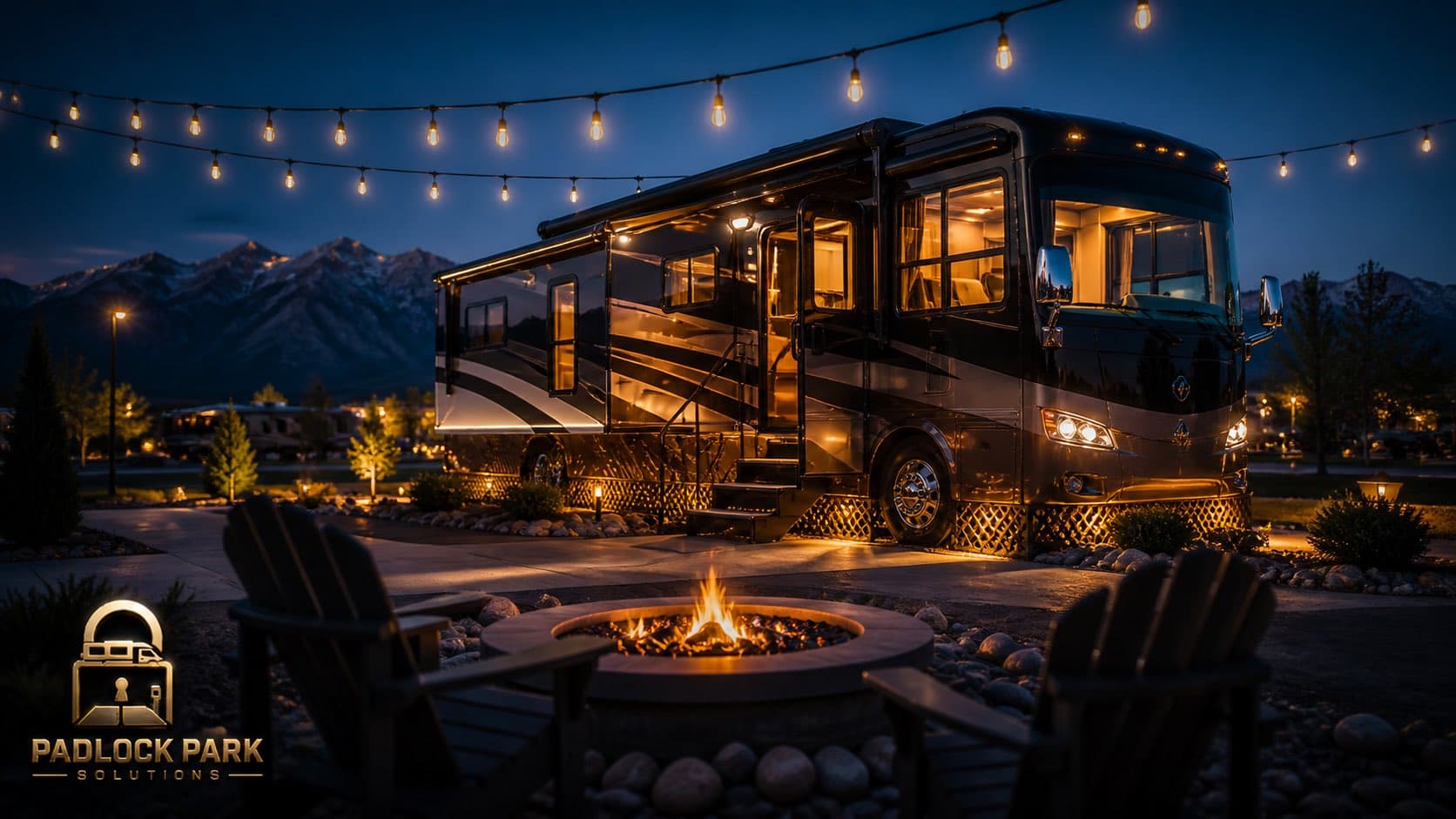
The envelope
Ceramic envelope. The pads stay cool.
Son Shield ceramic microsphere coating sealing every converted unit. Aerospace-heritage chemistry — millions of borosilicate vacuum spheres in a water-based acrylic, reflecting and emitting heat in a sub-millimeter film.
Solar reflectance
89%
CRRC certified
Thermal emittance
94%
Net solar absorption <2%
Fire rating
Class A
ASTM E84-23
Service life
14+ years
Documented field
What it does
In your terms.
For park owners
Class A motorhome roofs in the Sun Belt are solar ovens by 2 PM. Son Shield is the heat shield.
- The unit stays cooler — measurably. Independent field testing showed 7.2°F cooler interior temperatures, same conditions, no other changes. Tenants and guests don't run the AC as hard.
- Lower utility bills, fewer HVAC failures. Air conditioning under less strain. Compressors last longer. You're not replacing roof-mount ACs every other year.
- Class A fire rating. If your park is in a wildfire zone, every coat reduces ignition spread. The coating itself is rated by ASTM E84 — Flame Spread under 25, Smoke under 450.
- Spray application, fast cure. Airless spray, two to three coats, water-based cleanup. Done in a day per unit. No primer needed on most surfaces.
- Lasts. Ten-year warranty from the manufacturer. Documented field life on the Namhae Grand Bridge in South Korea: fourteen-plus years with no maintenance. You're not repainting in five.
For institutional capital
Roof-coating CapEx with measurable cooling-load reduction is one of the cleanest NOI lifts in stationary-RV operation.
- Documented cooling-load reduction. Independent St. Louis comparative study showed peak summer cooling savings of 30–60% on Son Shield-coated buildings vs. uncoated controls. RV-form-factor results trend within that range.
- Compounds with on-site generation. Lower kWh draw per unit reduces battery sizing requirements. CapEx on the power layer drops in proportion to envelope reduction.
- Wildfire-grade envelope. Class A fire rating per ASTM E84-23. Specialty graphene-fabric variant rated UL94 5VA and V0. Material survives short-term exposure to 2,000°F per KICT (Korea Institute of Civil Engineering) testing.
- Documented service life. Fourteen-plus years zero-maintenance on the Namhae Grand Bridge (since 2009). Ten-year manufacturer warranty. Salt-spray pass at 1,000+ hours per ASTM B117 — relevant for coastal Western US parks.
- Aerospace-heritage chemistry. Borosilicate vacuum-microsphere chemistry descended from NASA thermal-protection work via Gene Hammon. Water-based acrylic carrier. VOC at 0.33 lbs/gal — well below EPA limits, occupied-space safe.
Where it's been installed
Real installations. Verifiable.
- 2016–present
Incheon Youngjong Grand Bridge, South Korea
Asia's largest 3D suspension bridge. Coating survives 17 cm continuous structural vibration with no failure across 7+ years of service.
- 2009–present
Namhae Grand Bridge, South Korea
14+ years of zero-maintenance field service since application in 2009. Public infrastructure, third-party verifiable.
- Long-term
LG Headquarters Building, Seoul
Corporate headquarters façade.
- 10+ yr
Coca-Cola manufacturing facilities
10+ years documented performance on industrial roofing.
- Multi-year
NTT Communication towers, Japan
Telecommunications infrastructure thermal protection.
- Multi-year
Siberian electric transmission towers, Russia
Extreme cold-climate longevity application.
- 5+ yr
Subway station steel structures
Public transit infrastructure, 5+ years documented.
Source: Son Shield USA Knowledge Base. CRRC + ASTM + UL + KICT certifications on file. Available on request during a discovery call.
Application
How we put it on.
Surface prep.
Power wash. Spot-treat any active rust or contamination. No primer needed on most substrates including aluminum RV roofs, fiberglass, and painted metal. Surface and ambient temperature 35–100°F, RH below 85%, no precipitation 12 hours after.
Application.
Airless spray with 0.031" tip at 2,200–2,500 PSI is fastest. Synthetic roller or brush also valid for cut-in work. Two coats standard for walls, two to three coats on roofs, up to four for industrial heat-exposure applications.
Coverage.
75 sq ft per gallon on sloped surfaces; 32 sq ft per gallon on flat roofs (heavier film thickness). A typical Class A motorhome roof + exterior takes roughly 5–7 gallons total across two coats.
Cure + cleanup.
Touch-dry in 2 hours, recoat in 4 hours, full cure 24–48 hours. Water-based — soap-and-water cleanup. VOC at 0.33 lbs/gallon (39.5 g/L), well below EPA limits. Occupied-space safe during application.